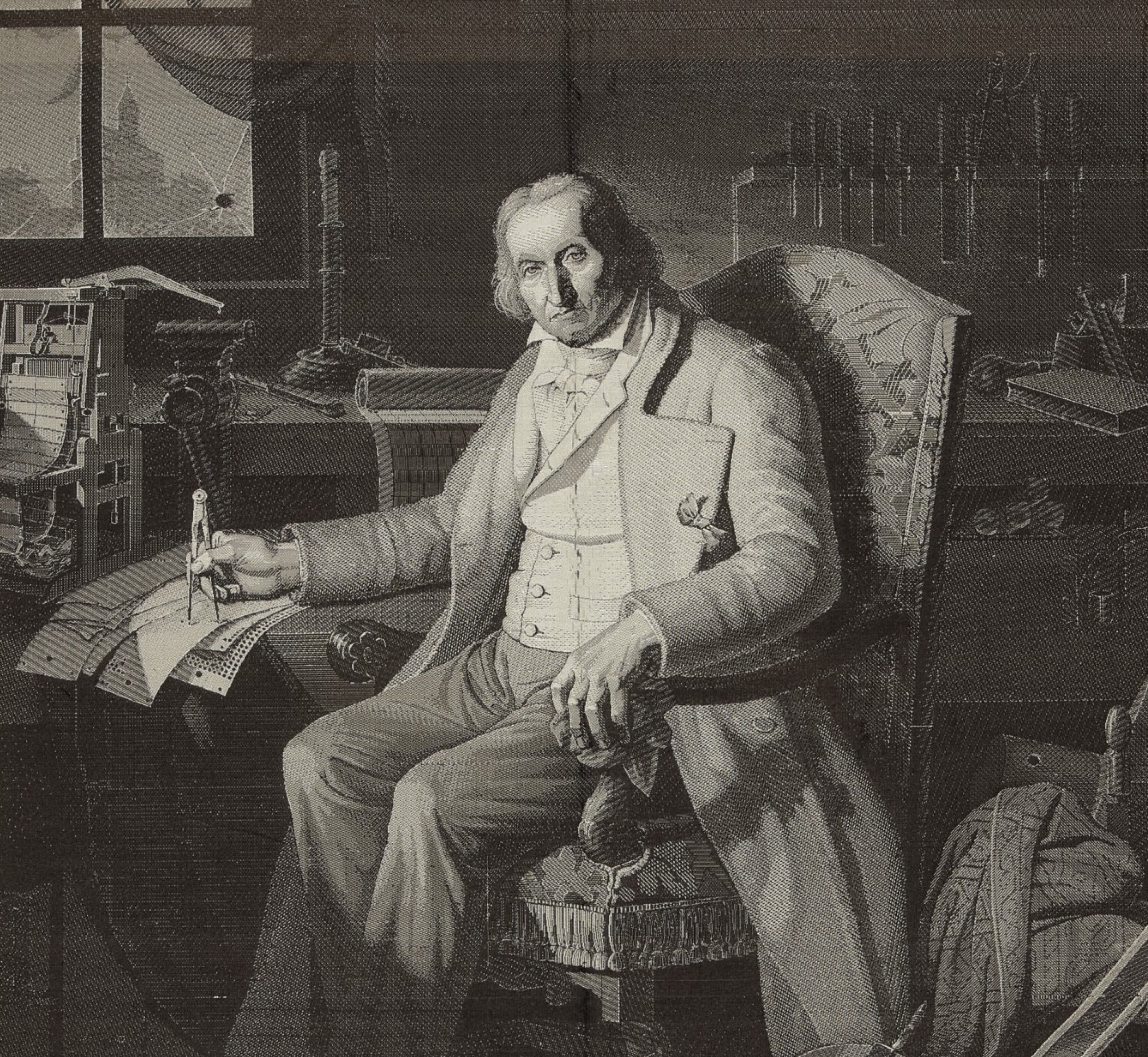
Joseph Marie Jacquard, Self-portrait woven on a Jacquard loom (1839) — The first machine that read instructions and acted on them. Thread by thread.
Agentic
adj.—running toward a result, with steps you didn't specify.
The word arrived in AI circles before it settled on a meaning. For the first few years of the current wave, "agentic" was used to describe anything that felt more like a capable assistant than a command executor—a system that took steps, tried again after failing, used tools, delegated subtasks. The bar kept moving, because the technology kept clearing it.
The working definition I use: agentic describes a system that doesn't just respond to a prompt but acts toward an outcome—planning, executing, evaluating, iterating, and calling on other systems along the way. The distance between a prompt and an output used to be a single inference call. An agentic system stretches that distance into something closer to a process: steps, sub-tasks, tool calls, verification loops. The output is no longer a completion. It's a result.
What changed the stakes was long-running execution. A system that acts for thirty seconds in a chat window is a novelty. One that runs a background routine, surfaces results when ready, and picks up where it left off—that's something structurally different. It acquires a kind of memory, a kind of continuity, a relationship with clock time that pure inference doesn't have. That's the threshold I find interesting: not the tool use, but the persistence.
The organizational question it raises is less technical than it seems. Agentic systems don't just change what software does—they redistribute who decides. A process that once required a human to approve each step can now run to completion on its own, surfacing for judgment only when something unexpected turns up. That's a shift in the architecture of control, not just the architecture of code.