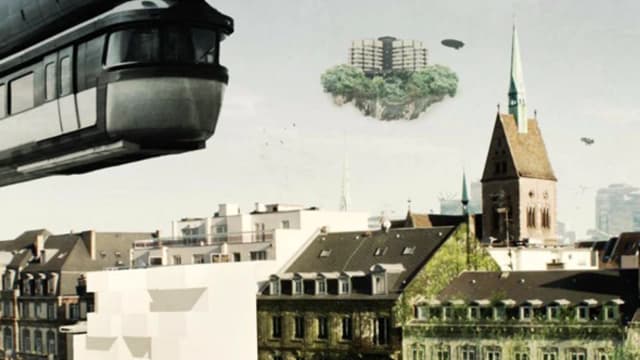
A few years ago, enormous capital went into building persistent virtual worlds—3D spaces, avatars, digital twins. The assumption was almost never questioned: these worlds were being built for us, humans walking through headsets into rooms and streets and shops. Then, mostly, we didn't show up. The usual verdict is that the Metaverse got overhyped, and it did—disorienting headsets, no compelling use case, empty rooms with legless avatars, etc. But there may have been a second thing wrong, beyond execution: the idea of building persistent digital worlds wasn't necessarily wrong, only who we assumed would live in them.
What made me think of this was Higgsfield shipping a plugin for Blender this week. Instead of asking a model to paint pixels directly, you generate a structured 3D scene first—objects, geometry, camera, lighting—then let AI paint that scene. The geometry lands as real, editable objects, not a rendered image. An MCP bridge even lets an agent build directly inside the open scene from a sentence. The human doesn't need to walk into that world. The world exists just because the machine needed somewhere to work!
The web already tried this
That's the inversion, in miniature: for thirty years, digitizing something mostly meant translating it into a form a human could look at—pages, apps, dashboards, virtual worlds. The web already has a quiet precedent for the alternative. When you load a page, you see text and buttons—underneath sits the DOM, a structure no human is meant to read directly. Browsers parse it, scripts traverse it, and increasingly agents reason over it and act on it. But the DOM was never built for us. It's a machine-actionable representation wearing a human-readable rendering on top.
The pattern repeats
The same pattern keeps showing up everywhere: language folded into latent space, physical dynamics compressed into world models, relationships turned into knowledge graphs, factories and cities encoded as digital twins, agents moving through filesystems. That intuition isn't new: Meta's Large Concept Models moved reasoning into a language-agnostic concept space back in 2024, and its Coconut paper kept reasoning inside a continuous latent state instead of decoding it to words at each step. None of these representations need to resemble the world we see. They only need enough structure for a machine to navigate, infer, and act on.
That may be the real flaw in the original Metaverse pitch, more than the hardware and the empty rooms. It tried to reproduce the physical world while keeping the human at the center—rooms, doors, streets, avatars, presence. A machine doesn't need any of that: not a door to open, not a street to walk down, not a face to be recognized by. It needs structure it can act on, and permissions telling it what it's allowed to touch. In Lewis Carroll's famous Through the Looking-Glass, Alice steps through a mirror into a world that corresponds to ours without belonging to it—familiar enough to recognize, sandboxed on its own side of the glass, running on a logic entirely its own. The chessboard, with its absurd, busy characters, is just the most visible piece of it.
What a universe actually needs
These last few years have brought real progress, both theoretical and practical, on two fronts at once: representing information more compactly, and moving through it more efficiently. Embeddings and latent spaces are the obvious examples, but the same push shows up in plainer forms too—workspace directory trees, index files, knowledge graphs, all quietly getting better at letting a machine find its way around. A collection of spaces like that is still just a set of maps, not yet a universe. But a paper published this week ran a fascinating study showing just how important the environment itself can be as a substrate for coordination.
SwarmWorld, from a team at MIT, puts hundreds of initially identical language-model agents into a shared, persistent environment with no assigned roles—and yet they spontaneously differentiate into explorers, builders, caretakers, coordinators, sorting themselves into roles nobody handed out. Unlike the pieces on Alice's chessboard, nobody sets the roles here before the game starts; the game produces them. They explore, build, and modify what earlier agents left behind—inheriting and forking each other's code without ever exchanging a message. Around 95% of a technology's first reuse happens simply because one agent encounters what another built, and up to 76% of the resulting artifacts end up with more than one builder.
The environment itself becomes the latent space for invention.
That's stigmergy—the mechanism ants and termites use to raise a colony without ever discussing the plan. I see a small version of it daily: agents sharing a filesystem rarely need explicit coordination—the files, and what an earlier pass left in them, carry enough context on their own. It has its own fragility, too: delete half the agents at random and 98% of the technology stays connected, but remove the hub agents specifically and that collapses to roughly 60%—the society that looks leaderless still has load-bearing nodes.
The most striking test removes every agent entirely, then exposes what's left to disturbances it never encountered. The infrastructure keeps functioning. The intelligence that mattered wasn't only in the agents. Some of it had already moved into what they built.
The intuition that held up
Maybe that's the one part of the original Metaverse pitch that was never actually wrong. It never needed a keynote, a headset, or a marketing budget behind it. It materializes quietly, already, every time a swarm of agents works through a shared filesystem without anyone coordinating them by hand. It materializes in the vast, abstract latent spaces algorithms now move through—encoded representations of our own reality, growing a little less intelligible to us with every new version.
Some sort of Machinaverse, arriving on its own, without needing anyone to launch it.