It has been one year since our Michelin digital team began to explore the potential of generative AI in enhancing our consumer experience.
Beyond all the prototypes and features built, this year of exploration with my team has been immensely valuable for understanding this new paradigm, and from this I have drawn a few thoughts.
We are experiencing a historic technological moment. In some ways, it reminds us of the early days of the internet era, with its explorers, pioneers, and also its first major ideological divides. Generative AI sparks excitement and uncertainty, both at unprecedented levels. It collides with our organizations, questions our ways of designing products and massively re-purposes investments.
By reducing the friction of traditional UIs and APIs, natural language offers a seamless interface between users and agentic systems—and between systems one to each other—bringing digital experience to the next level.
Brands that invest in these dialogue technologies with their customers will find a goldmine of business insights, and just as many opportunities to recreate those digital market "conversations" that were predicted as early as 1999 by the authors of the Cluetrain Manifesto.
The challenge is as much technological as it is ethical, ensuring that technological advancements do not compromise our genuine relationship with customers, but instead enrich it.
It looks like vectorization of unstructured datasets and similarity search across embeddings are setting the stage for more intuitive and capable AI systems, while exciting properties emerge from the scale at which LLMs operate—knowledge compression, transfer learning, and more.
Today's AI is sitting on the shoulders of giants: as it seeks a sustainable development model that benefits everyone, let us acknowledge how much it owes to the generations of researchers who preceded it, building the foundational knowledge and tools that have propelled this field forward. As open-source AI solutions gain traction in performance benchmarks, they carry forward this tradition, while resisting the temptation to establish closed ecosystems and captive, profit-oriented models.
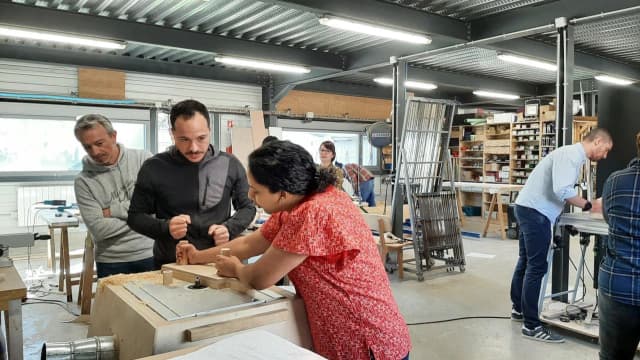
Despite the increasing complexity of technology, this moment ultimately honors a certain craftsmanship—a mix of expertise and creativity. Indeed, it has been a long time since we've seen such speculation around technologies that are, after all, very experimental and built from the expertise of a small minority of experts.
Many see in artificial intelligence only its "robotic" aspect, falling into the dual trap it holds: blissful techno-futurists on one side, a sterile fear on the other. Why don't we rather take it as an opportunity to acknowledge the endless possibilities that mathematical language holds, and rediscover our sense of responsibility? Artificial does not mean magical, but on the contrary, "made by our hands, crafted with art"—as its etymology suggests (arti-fex).
To me this is yet another reason for my team—and our companies—to dive into this with determination and a desire to learn, rather than purchasing one-stop, blackbox solutions to which we are gradually surrendering our collective cognitive faculties, and our sovereignty.
As we open a new chapter in our AI scale-up, I am grateful to the amazing explorers of my team who have paved the way to it—especially Soheir Benyagoub for sparking it just one year ago—and I am equally impressed by the speed and mastery with which so many of my teammates have embraced AI technologies, whether for their own productivity or to build consumer-oriented features.
Moving forward, I know we can ground our vision upon the team's past experience of building over 500 websites in-house, out of the finest open-source technologies. I'm also confident that a voluntary, teamwide upskilling on AI, leveraging partnerships with the right stakeholders from the AI ecosystem, can create momentum. But I equally believe in my team's software craftsmanship to tackle this new AI playground and chart a technological and ethical path that reflects who we are.