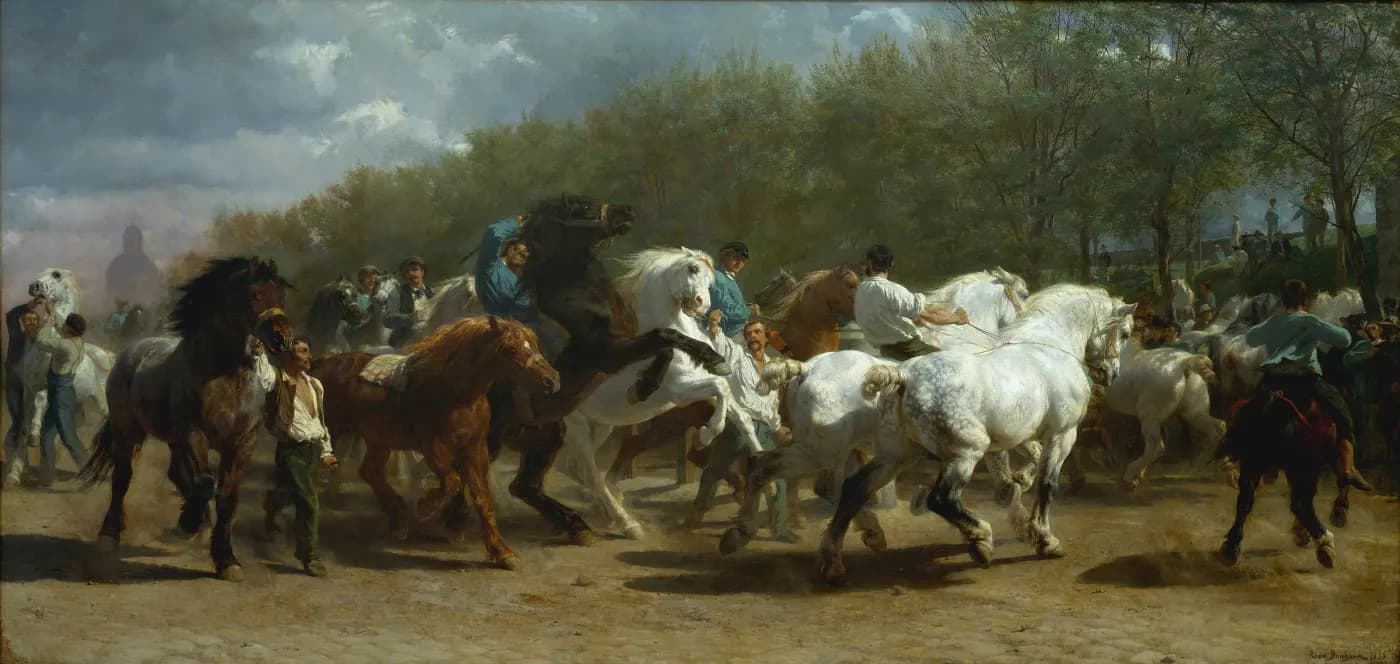
Rosa Bonheur, The Horse Fair (1853) — The horse is the power. The harness is the direction.
Harness
n.—what survives when the model doesn't.
A harness is everything you build around a model that doesn't disappear when the model changes: the workflows, the evaluation systems, the proprietary data, the agents, the MCP servers, the operating practices. The model is replaceable by design—it gets better, cheaper, or restricted on a timescale measured in months. The harness is what you actually own.
The formulation I use here comes from Vivek Trivedy at LangChain: Agent = Model + Harness. In his definition, the harness is everything around the model—code, configuration, and execution logic—that turns raw intelligence into useful work. The older, horse-drawn meaning happens to fit precisely. A harness doesn't generate power. The horse does that. What the harness does is take raw, undirected force and turn it into something you can steer—a plough line, a cart, a specific field getting worked instead of trampled. Frontier models are the horse: extraordinary, slightly wild, and indifferent to your org chart. The harness is the only part of the system that is actually yours to design.
This is why I keep returning to electrification as the closer analogy. The greatest beneficiaries of reliable current were never the power plants—they were the factories and cities that rebuilt how they worked once electricity could be trusted to show up. The model is becoming the grid. What you build around it is the asset. An organization that spends its energy optimizing for this quarter's best model, instead of the harness that will outlive it, is wiring its factory floor to one specific power plant, then acting surprised when the contract changes.
The geopolitical version of this lesson arrived early and loudly: a frontier model can be made unavailable within hours, by a government, a platform partner, an export-control directive—for reasons that may have nothing to do with the technology itself. Access to a model was never the same thing as control over a capability. The harness is what's left standing when access gets revoked.
None of this is an argument for caution. It's the opposite. The fact that models keep moving is exactly why the harness—not the model—deserves the engineering effort. Use frontier models as accelerators. Never let one become the control point of the architecture.