AI may be triggering a Copernican revolution in enterprise information systems. The question is not whether the revolution has started, but rather how far it will go, and on what time scale gravitational recompositions will actually happen.
For decades, enterprise software was organized around heavy stars: ERP, CRM, office productivity suites, etc. Workflows, data models, interfaces, procurement, and governance all orbited around them.
That architecture created order—as well as dependence—and in large part, software prescribed work. Users adapted to forms, fields, states, and predefined workflow transitions, despite efforts to tailor them as per "business processes."
At times, this also produced excesses: hyper-reporting cultures that turned parts of organizations into what Pierre-Yves Gomez calls "spreadsheet companies," sometimes pursuing the metric itself more than its underlying purpose, in classic Goodhart fashion.
The Old Sky and the "Cognitive ERP" (Wrong) Analogy
Recent Claude-like announcements and equity-killing enterprise agent/plugin ecosystems made one idea popular: AI would be becoming some kind of "cognitive ERP," breaking the whole enterprise software value chain.
At first glance, the analogy looks thought-provoking. It gives executives a familiar mental model for an unfamiliar shift. Indeed in most large companies, ERP, CRM and office suites worked like "heliocentric" frames, standing as gravity centers for transactional records, customer processes or the general cognitive interface for the white-collar workforce.
In this operating principle, determinism, traceability, and standardization were the source of control. But this misleading analogy compares two radically different things—and I would even say diametrically opposed ones.
ERP is a system of record. AI is not.
ERP is transactional, stateful, deterministic, and built around hard contracts. Agentic AI is fundamentally probabilistic, contextual, loosely coupled, and built around orchestration.
This is precisely why agentic frameworks have emerged, on top of early LLMs: because of generative AI's probabilistic nature, AI-only internal "reasoning" could not support reliable transactional process. Agentic patterns therefore externalized the chain-of-thought: decomposing tasks, exposing intermediate steps, and adding verification loops to restore a minimum of reliability and observability when acting across application layers. In that sense, the agent layer became like an exoskeleton around the generative "cognitive muscle" of the model—structuring and stabilizing something that is intrinsically incompatible with the process reliability required by enterprise systems.
In any case, AI comes in to interpret, route, compose, and act across existing systems. It does not become the legal, accounting, or operational source of truth.
So for my part, I think it is a mistake to oppose the two, because they are not substitutable. What we are likely witnessing is an inversion of gravity. ERPs and CRMs certainly won't disappear anytime soon but the adaptation workload—the "gravity"—may invert over time.
The Inversion: From Prescribed Flows to Adaptive Orchestration
For thirty years, enterprise software mainly asked: "How do we force reality into stable process models?"
Now agentic systems ask: "How do we interpret real situations and dynamically assemble the right actions?"
As a visible signal, let us look at Microsoft: for years, the productivity cosmos was organized around the Word/Excel/PowerPoint triptych (and equivalent competitors).
Now the narrative center has shifted. Copilot is increasingly positioned as the primary interface layer, with documents becoming downstream artifacts. Beyond the marketing narrative update, this looks like a reference-frame shift, from app-centric interaction ("Open Word, then write. Open Excel, then analyze. Open PowerPoint, then present.") to intent-centric orchestration ("State the objective, let the system compose data, text, visuals, and actions across tools.")
A few years ago, Notion had already pioneered a wedge in the old model. By reducing content and workflow primitives to recomposable blocks, it weakened the rigid boundaries of classic productivity objects.
That logic looked like UX innovation, but in hindsight, it also prefigured AI artifacts: modular, recomposable, executable units of work. At that time, the market reacted fast, as Google, Microsoft (the "Loop" copycat), and others replicated versions of the same direction: less fixed document gravity, more composable units in dynamic workflows.
From Software Planets to Orchestration Fields
For my part, I really think that what may change is not just UI, but enterprise gravitational topology. In such a shift, the center of gravity for large enterprise software could be moving from owning the screen, owning the file format, owning the transactional shell, toward owning orchestration context, owning agent routing and policy, owning cross-system memory and action surfaces.
Ultimately, ERP and CRM would remain massive bodies, and certainly not evaporate, but they may no longer be the only stars around which cognitive work must orbit. Monolithic backbones—including HR/finance platforms like Workday—could be rapidly, and productively, resurfaced by new UI layers as agentic composability pressures them to open interfaces, while the marginal cost of building tailored UIs keeps collapsing.
The heliocentric ERP/CRM/Office frame could be taking a direct hit.
Anti-ERP Does Not Mean Anti-Governance
Loose coupling is not chaos. Agentic layers will need policy boundaries, audit trails for actions, permissioned tool access, reliability checks, human-in-the-loop controls for high-impact decisions.
So the future may certainly not be system-of-record replacement, but rather a more layered recomposition: systems of record keep transactional truth, agentic layers orchestrate cognitive and operational execution—with the same magnitude as API and system-to-system revolutions did a while ago—and interface layers mediate human intent.
This is closer to an "RPA 2.0" pattern: not brittle click-automation, but guided agent orchestration over enterprise events, documents, connectors, and reusable playbooks. The performance ceiling still depends on decomposition quality, scripted standards, and domain constraints.
The rollout of all these guardrails is, by itself, the best argument for a slower timeline: at-scale agentic AI integration in industrial enterprises (not digital-native startups) will take years. This inherent friction is a "viscosity" parameter in the paradigm-shift time equation underway.
But there is also a real risk: organizations that move too slowly may become prey in a system that tends to uberize what cannot reconfigure fast enough, especially in today's high-volatility economic environment.
In IS/IT context, this could also take the form of rushed compromises with dominant platforms, able to absorb—often at low cost—cognitive ecosystems that organizations could no longer afford to maintain themselves, only to "rent access" back later under far less favorable conditions. We have seen this logic at work several times in recent history. Sometimes for good reasons, sometimes not.
Markets and Architectures Are Strategic Games, Not Physics Experiments
One caution matters. Or rather three.
At macro scale, prediction is hard and observation bias is huge. The density of one's hyper-parameterized LinkedIn flow does not reflect day-to-day enterprise reality, where AI adoption is still often embryonic.
Micro signals do not map cleanly to macro outcomes. In IT architecture as in labor markets, local transformations can be real and still fail to generalize.
Unlike celestial objects, market actors are strategic. Vendors, integrators, CIO teams, regulators, and incumbents continuously adapt to one another.
This is less pure celestial mechanics, more competitive, multiplayer chess.
Importing Antigravity
So yes, AI is somehow introducing "antigravity" into enterprise software.
Certainly not by deleting ERP and CRM, nor the nebula of software objects orbiting around them. But rather by reducing their exclusive gravitational monopoly over how work gets done.
Maybe that is the real shift: certainly not a new "cognitive ERP," but a new gravitational field for cognitive work.
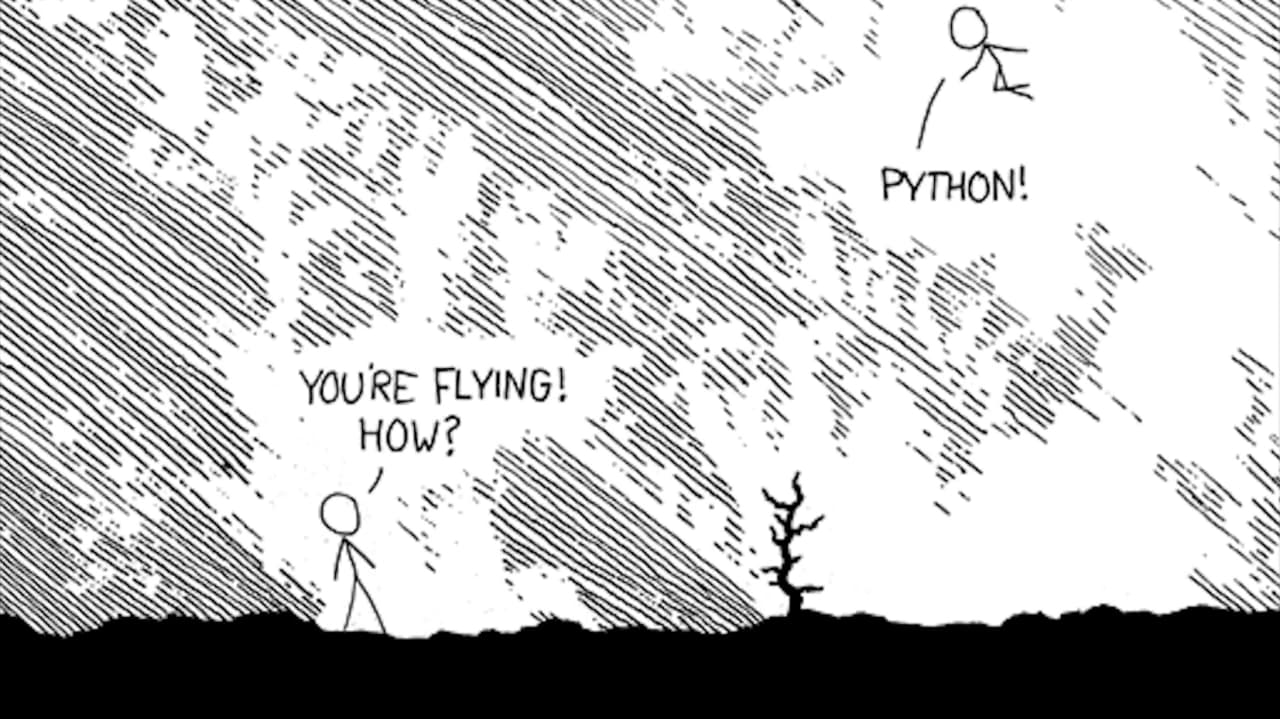
That famous Python easter egg makes someone fly with a single command. In a similar way, Claude-style AI systems now cut through decades-old certainties with disarming ease, using just a few Python or shell commands orchestrated by increasingly reliable agentic runtimes.
"Bash is all you need" is the philosophical shortcut for this claim, that minimalist AI agent architectures based on Unix, with simple shells and modular tools, can outperform complex, over-engineered systems.
This "minimalist" signal should not be dismissed. Agentic AI may provide a powerful way to cut through decades of accumulated enterprise complexity, ultimately reshaping how people access systems, workflows, and information.
But as discussed above, this certainly does not mean the software stack will be overturned overnight—even though it does open a window for meaningful simplification, and we should take it.
Looking outside, recent market overreactions ("SaaSpocalypse") are probably closer to speculative fiction than to a real, short-term migration of value and inertia, even though they could also become self-fulfilling prophecies: market value collapse forcing business-model changes, and sometimes architecture pivots, across incumbent SaaS platforms.
It is also worth noticing that for large enterprises, vendor equity storms also re-balance bargaining power, opening negotiation windows that loosen the grip of sometimes captive SaaS models.
One final note of prudence: in celestial mechanics, once you move beyond three interacting bodies, exact long-term trajectories become notoriously hard to solve—if not completely chaotic.
Enterprise recomposition may follow the same rule: we can identify forces, we can observe perturbations, but we should stay careful about deterministic forecasts.
A Copernican moment may be underway for enterprise information system architectures, but its final orbits are still being written.