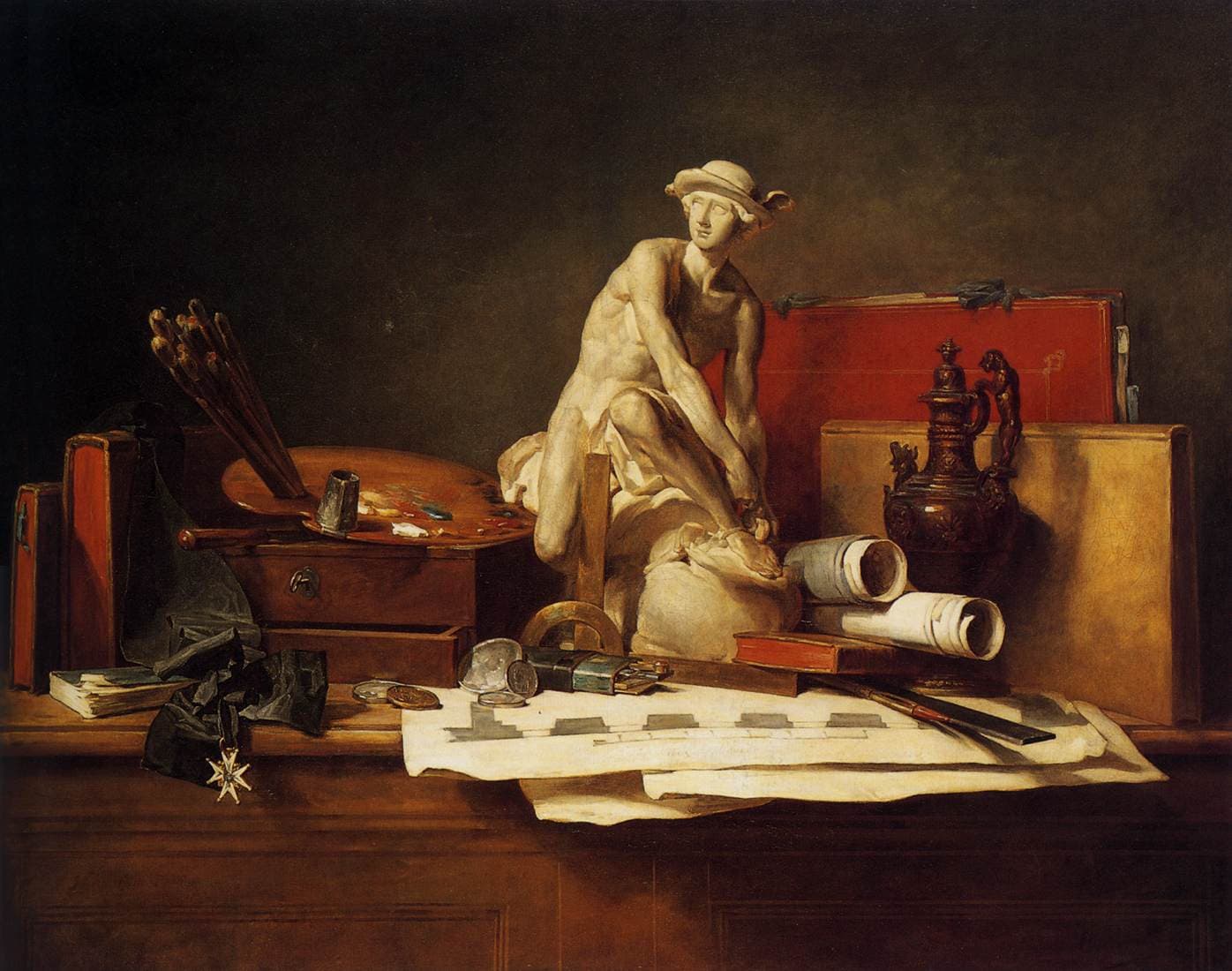
Jean-Baptiste-Siméon Chardin, The Attributes of Art (1766) — Tools waiting for procedure.
Skills
n.—a tool with memory of how it's been used before.
Where a tool provides capability, a skill provides know-how. The cleanest definition I've settled on: a skill is reusable, versionable logic that describes how a task should be performed—implemented as code, a workflow, a prompt, or a specialized agent routine—and that typically orchestrates one or more tools along the way. A tool is something an agent uses. A skill is something an agent executes.
The distinction tracks something real in how human expertise works, too. A tool is closer to an instrument—a calculator, a wrench, an API call. A skill is closer to a learned procedure: knowing not just that a wrench exists, but which torque to apply, in which order, on which kind of bolt, after having stripped a few threads the wrong way first. Skills accumulate judgment in a way raw tools don't. They're the procedural layer sitting above the capability layer—the difference between having a kitchen full of equipment and actually knowing how to cook.
What I find genuinely new is that this layer can now be written down, versioned, and shared the way code is—portable artifacts that travel between teams, between agents, between organizations, carrying procedural judgment that used to live only in someone's head or in an onboarding conversation nobody wrote down. That's the part worth taking seriously: not that agents can now act, but that the how of acting well can finally be captured as something other than tacit knowledge that walks out the door when an expert leaves.