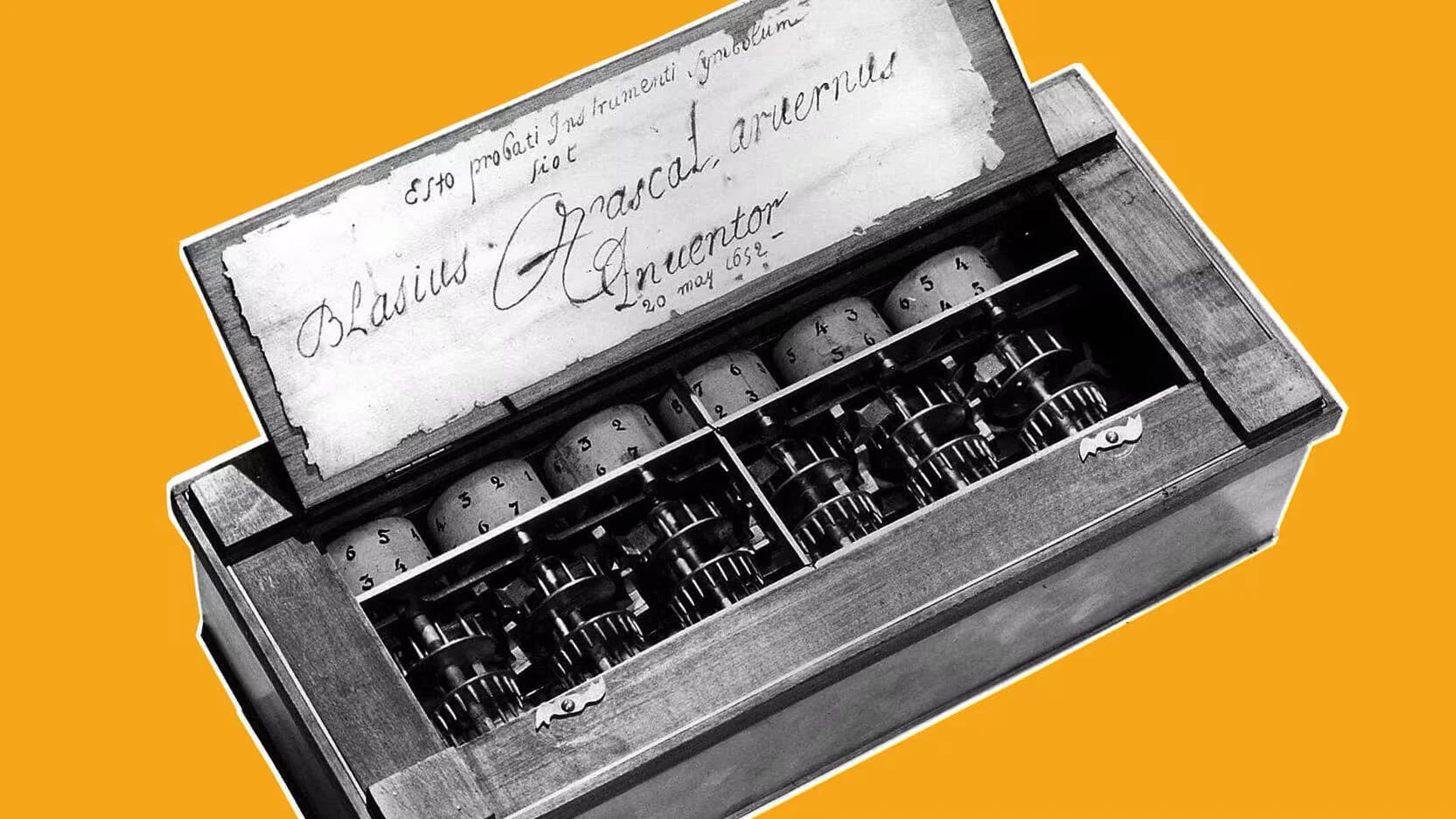
Blaise Pascal's arithmetic machine, signed and dated 1652 — Arithmetic, handed over to the machine. © via imago-images.de / Album / Oronoz
Pascal
n.—a machine for calculation, a method for uncertainty.
During his short and incredibly productive life, Blaise Pascal built two things that don't, on first glance, belong to the same person: a calculating machine, and the mathematics of chance. The Pascaline—gears and dials, built to spare his father a tax administrator's tedious arithmetic—was a commercial failure, too expensive to produce at scale. The probability theory he developed with Fermat, working through a gambler's dispute about how to split stakes in an interrupted game, became one of the strongest ideas of modern mathematics.
I keep coming back to the fact that these were not two separate Pascals. The same mind that wanted to mechanize calculation also wanted to formalize uncertainty—to make rigorous the thing that feels, by definition, least rigorous: not knowing what happens next. He didn't see those as opposite impulses. He saw a machine for what's certain and a method for what isn't, built by the same hands, in the same years.
Today's AI largely inherits from both. The hardware lineage runs through the Pascaline—mechanism replacing manual computation. The statistical lineage runs through his work on probability—a model that doesn't know the answer, only the odds. An LLM is, in the most literal sense, a Pascalian object: a machine that calculates, built on a foundation that calculates likelihood rather than truth.
Pascal also famously imagined Le Pari (the Wager)—the argument that under genuine uncertainty about God, belief is still the better bet. Whatever you think of the theology, the structure of that argument is exactly the structure of every serious decision about a technology whose long-term consequences nobody can fully compute. He built the machine, the math, and the argument for how to act anyway. Three centuries later we're still doing the same arithmetic, only with better hardware.