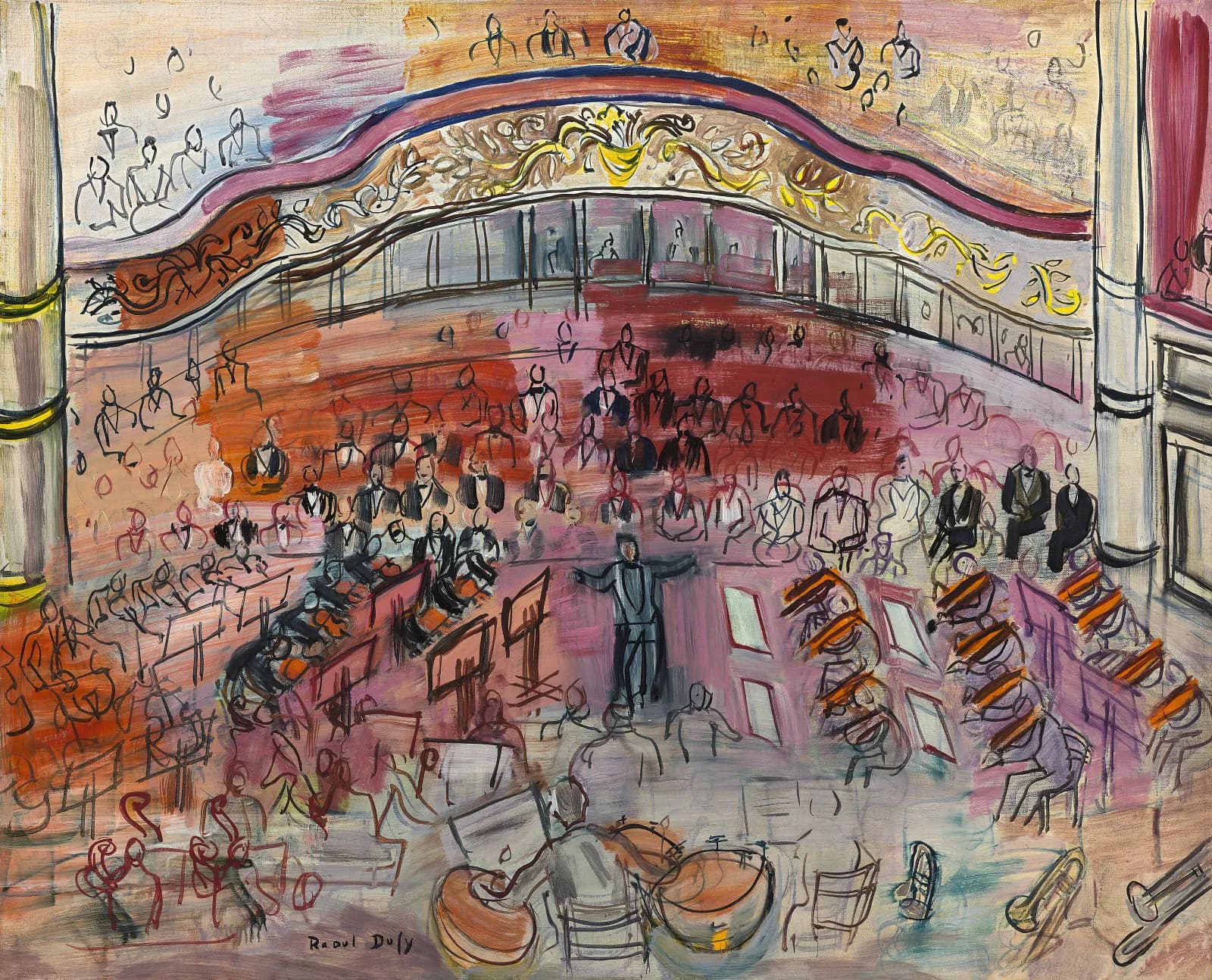
Raoul Dufy, Le Grand Orchestre, 1942 — No instrument plays the others. Something still decides who goes next.
Operating System
n.—whoever decides what runs first.
An operating system has never been where the interesting computation happens. It's the layer that decides whose turn it is—which process gets the processor, which request gets memory, what runs now and what waits. The actual work—the spreadsheet calculation, the rendered page, the compiled program—happens above it, in applications the OS doesn't really understand or care about. The OS's entire job is arbitration.
That's worth remembering every time "the new OS" gets used as a metaphor for the current AI moment—LLMs as the new OS, agents as the new OS, whichever platform is making the claim this quarter. The metaphor is usually reaching for something else: not arbitration, but centrality. What people mean is "the layer everything else depends on." That's a real claim, but it's a different one, and mixing the two hides the actual question worth asking.
The real OS question for the agentic era is closer to the original meaning than the marketing use of the phrase: who decides what runs, in what order, with what priority, when multiple agents and processes are competing for the same resources—compute, context, a human's attention? That's an arbitration problem, not a centrality problem. Whoever solves it well doesn't necessarily own the most visible layer. They own the scheduler nobody sees, deciding, underneath everything else, whose turn it actually is.