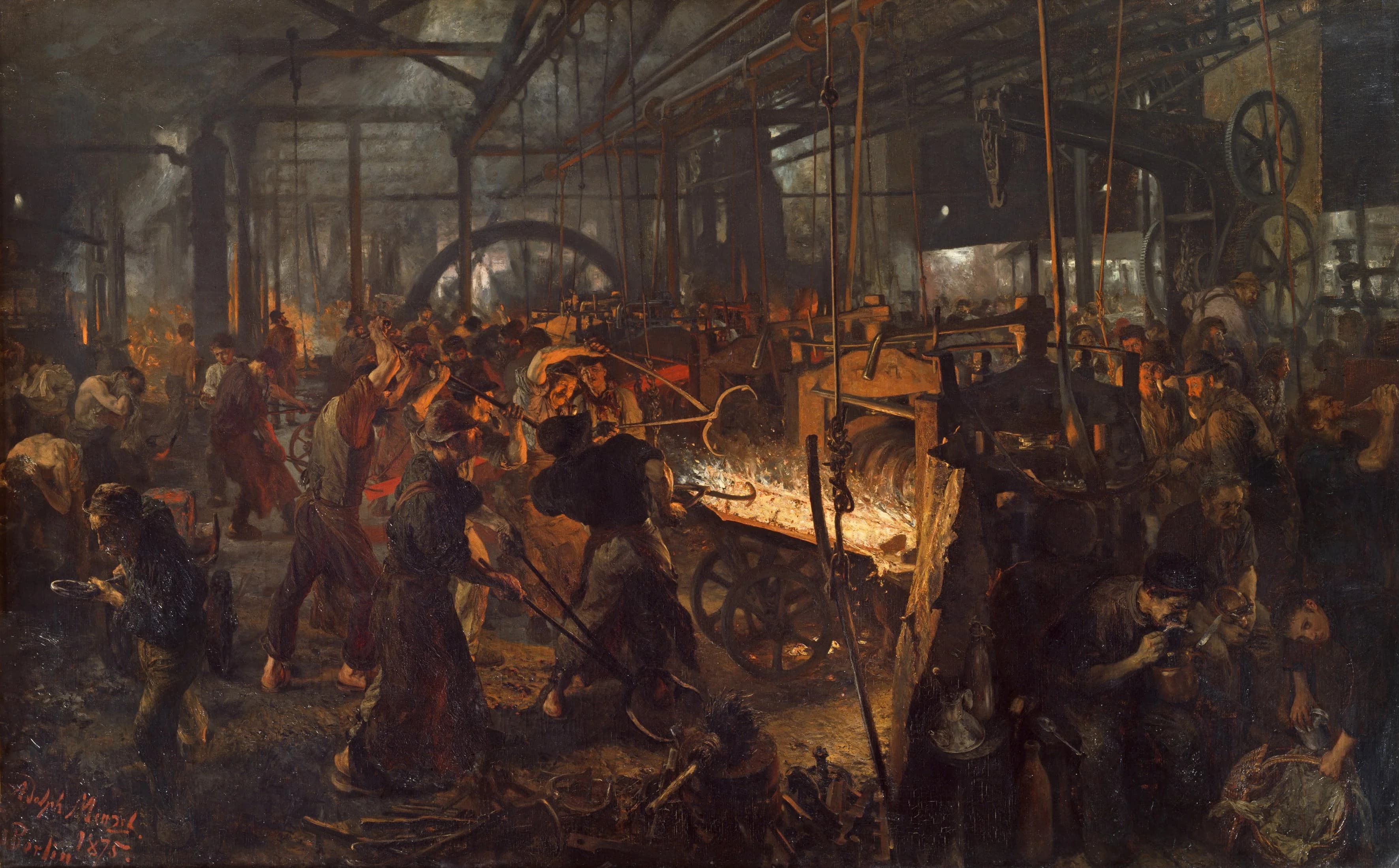
Adolph von Menzel, The Iron Rolling Mill (Eisenwalzwerk), 1872 — Nothing here is finished. Everything is mid-strike.
Forge
n.—where the repo and the furnace are the same word.
English made the connection less visible and French kept it visible: forger, to forge, still keeps the link to the blacksmith visible. Factory drifted in from the Latin factoria, a trading post, a place where things got made and moved—distant cousin to fabricare, to fashion, which goes back to faber, the one who works with skill at the forge. Strip it all the way down and the chain reads: forge, then fashion, then fabricate, then factory. Heat and hammer, before any of it meant assembly lines.
I like that the software world kept the word without noticing the inheritance. A "forge" is what we call a place that hosts source code—GitLab, a self-hosted Git server, the thing your platform team stands up so engineers have somewhere to push commits. Nobody chose that word for its etymology. It survived because it was already the right shape: a place where raw material—half-formed ideas, broken builds, ugly first attempts—is heated, combined, and re-formed into something that holds. The transformation is partly mechanical and partly chemical: tools, constraints, and other people act as catalysts, making possible changes the material would not reach on its own.
A forge is not a museum. Nothing sits there finished. Everything in it is mid-transformation, heated not only to make it malleable but to reveal what survives the fire and the next strike. That's closer to what a healthy codebase actually feels like than most of the language we use to describe software—"deployment," "release," "ship"—which all imply an ending. The forge implies the opposite: the work is never really done, only brought to a state coherent enough to be tested, shared, and worked again.