OpenAI showed off a new chip this week: Jalapeño, pitched with the obvious line: faster and cheaper than Nvidia. An independent lab ran its own benchmark rather than taking the slide at face value, and the gains hold up—real throughput and latency improvements, not just a marketing number.
What the chip is actually saying, though, isn't "we're faster." It's "we have an escape route."
The same pattern, everywhere you look
The same instinct is on display across almost every relationship in AI right now.
Nvidia guarantees tens of billions in financing to help OpenAI build out the data centers it needs—while also investing directly in Mistral and co-developing open models with it, financing the exact kind of alternative that could one day make an OpenAI relationship less essential. Morgan Stanley recently gave Nvidia its first-ever credit rating, flagging a large and growing pile of contingent, off-balance-sheet commitments that ordinary leverage ratios don't capture. Their name for what Nvidia has effectively become to the rest of the industry: Balance-Sheet-as-a-Service (BSaaS).
Conventional leverage increasingly understates the credit story—BSaaS, for short.
Microsoft ran a version of the same play with Anthropic directly. It struck a multibillion-dollar Azure compute deal, then launched Copilot Cowork on top of Claude, presented as an open, multi-model partnership—no single-vendor lock-in, model-agnostic by design. All while building the in-house MAI models that let it depend less on that same partnership going forward: paying two frontier labs' API rates on every Copilot prompt was never a comfortable place to stay, and the in-house line-up gives Microsoft a way to frame the Anthropic partnership as a choice rather than a dependency.
Google, for its part, holds a stake in Anthropic large enough that a meaningful chunk of Google's reported "AI profits" this year has really just been that stake appreciating on paper, not the underlying business performing—while Google spends the rest of its balance sheet trying to build the model that beats the company it partly owns.
The same instinct shows up one layer down, too. OpenAI just launched its own Deployment Company—$4 billion, 150 Forward Deployed Engineers, majority-owned by OpenAI—to embed directly inside client organizations and run their AI systems for them. That's the exact function consultancies and integration platforms have built businesses around, several of whom are now named co-funders of the venture that competes with them. Palantir's Alex Karp has been the loudest voice arguing the opposite case, warning enterprises off signing directly with labs that want to own their infrastructure and their data—while, by his own account, most of what Anthropic shows off in public is running on Palantir's stack. Different position in the same stack, same fight: who gets to sit between the model and the customer.
Not betrayal. Mutual disintermediation.
None of this is betrayal, exactly. Call it mutual disintermediation: each side uses the other to get through an exponential capex phase, while quietly building the option not to need it later. It's a rational thing to do as long as final demand keeps growing fast enough to justify all of it. The risk shows up the moment growth slows, because that's the moment everyone finds out how much of that demand was ever external to the system financing it.
Why the exit doors are opening now
Early on, this kind of mutual dependence makes complete sense: two parties who genuinely need each other, neither one clearly on top. What doesn't scale is staying in that position. The arrangement only holds up at size if each side eventually builds itself an exit—some credible way, even a mostly theoretical one, to say it isn't structurally stuck with a single partner. That pressure is sharpest right now for an obvious reason: several of these companies are approaching public markets around the same time, and an investor writing that check wants to hear the company isn't captive to one supplier, one distributor, one backer. Jalapeño is that story for OpenAI. The MAI model line-up is that story for Microsoft. Different players, same instinct, one level of the stack after another.
Two hands, then a gallery
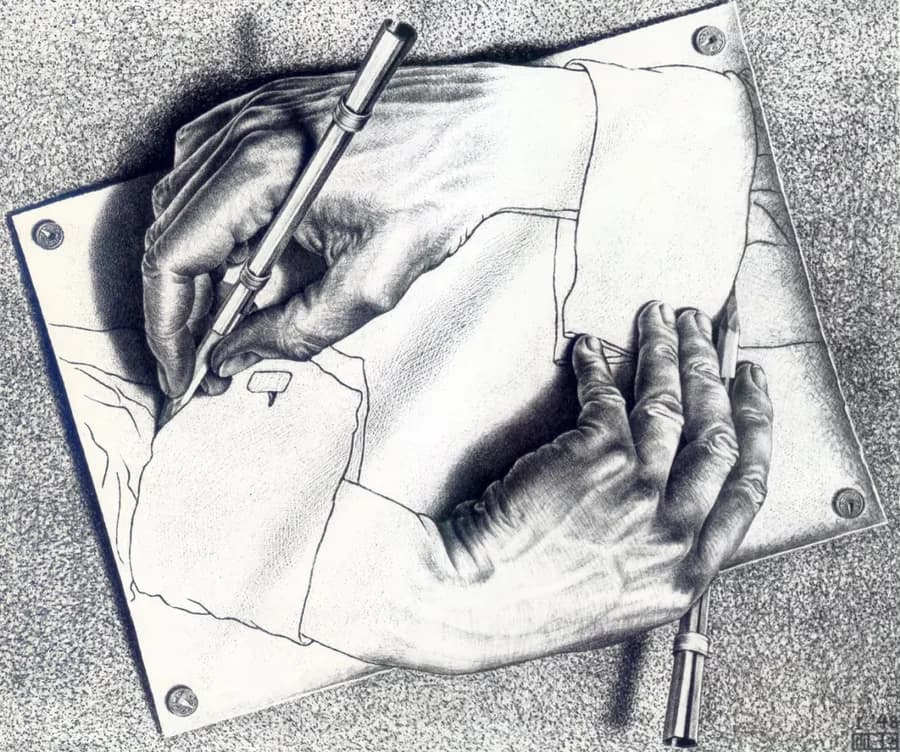
Two Escher lithographs sit on either side of this timeline. Drawing Hands (1948)—two hands sketching each other into existence, no way to say which came first—is the honest picture of the early phase.
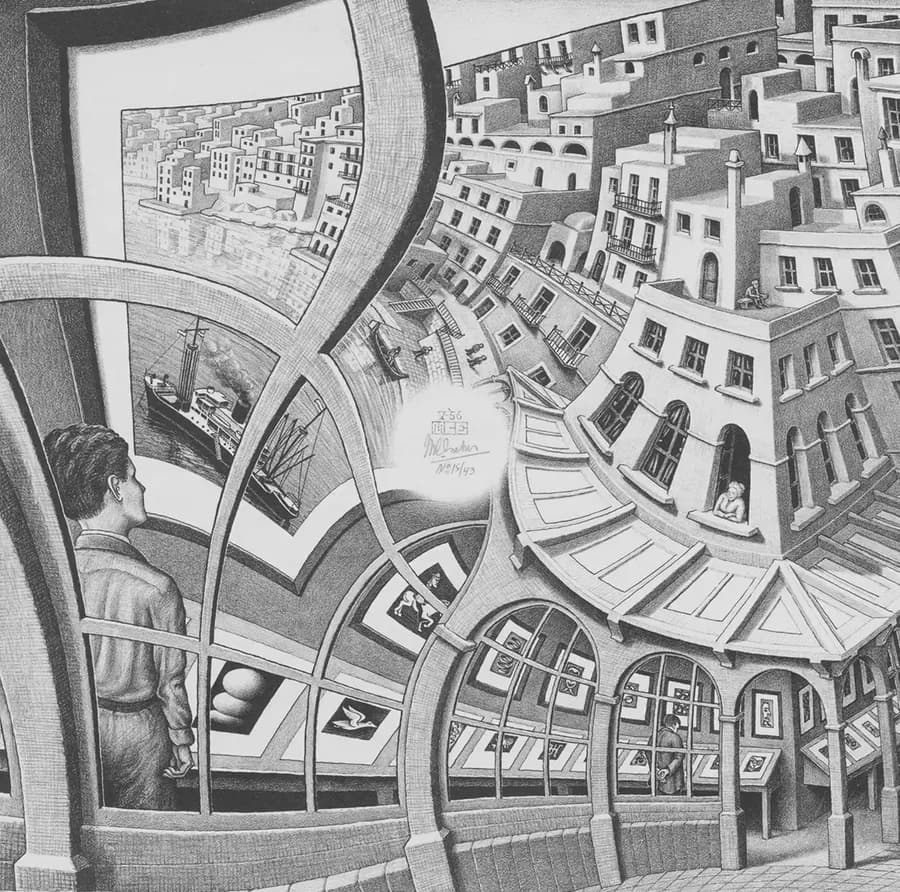
What fits better now is his other loop, Print Gallery (1956): a man in a gallery looks at a print of a town that curves and widens until it becomes the very town containing the gallery he's standing in.
The question both IPOs will have to answer
How much of this is demand for something people actually need, and how much is the industry financing its own reflection back to itself? The IPOs already lining up will ask that question for everyone else, whether anyone's ready or not.
* * *
PS: a small word about the painting above—none of it exists. The anonymous painter, the Dutch School, the c. 1660: all invented, and the image itself is AI-generated. Baudrillard opened Simulacra and Simulation (1981) with an epigraph he attributed to Ecclesiastes—a line Ecclesiastes never wrote, closing on his own verdict: "the simulacrum is true." Increasingly, that simulacrum of truth isn't sitting on top of the financial structure. It's load-bearing. Stop believing in it, and something underneath actually comes down.